
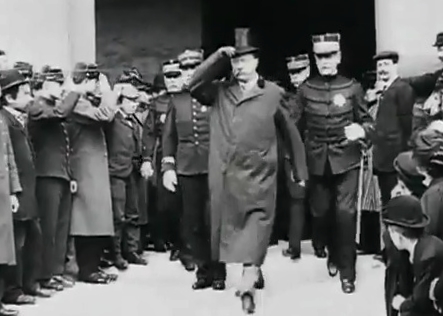
Strange and impressive associations rise in the mind of a man from the New World who speaks before this august body in this ancient institution of learning. Before his eyes pass the shadows of mighty kings and war-like nobles, of great masters of law and theology; through the shining dust of the dead centuries he sees crowded figures that tell of the power and learning and splendor of times gone by; and he sees also the innumerable host of humble students to whom clerkship meant emancipation, to whom it was well-nigh the only outlet from the dark thraldom of the Middle Ages.
This was the most famous university of mediaeval Europe at a time when no one dreamed that there was a New World to discover. Its services to the cause of human knowledge already stretched far back into the remote past at a time when my forefathers, three centuries ago, were among the sparse bands of traders, ploughmen, wood-choppers, and fisherfolk who, in hard struggle with the iron unfriendliness of the Indian-haunted land, were laying the foundations of what has now become the giant republic of the West. To conquer a continent, to tame the shaggy roughness of wild nature, means grim warfare; and the generations engaged in it cannot keep, still less add to, the stores of garnered wisdom which where once theirs, and which are still in the hands of their brethren who dwell in the old land. To conquer the wilderness means to wrest victory from the same hostile forces with which mankind struggled on the immemorial infancy of our race.
The primeval conditions must be met by the primeval qualities which are incompatible with the retention of much that has been painfully acquired by humanity as through the ages it has striven upward toward civilization. In conditions so primitive there can be but a primitive culture. At first only the rudest school can be established, for no others would meet the needs of the hard-driven, sinewy folk who thrust forward the frontier in the teeth of savage men and savage nature; and many years elapse before any of these schools can develop into seats of higher learning and broader culture.
The pioneer days pass: the stump-dotted clearings expand into vast stretches of fertile farm land, the stockaded clusters of log cabins change into towns; the hunters of game, the fellers of trees, the rude frontier traders and tillers of the soil, the men who wander all their lives long through the wilderness as the heralds and harbingers of an oncoming civilization, themselves vanish before the civilization for which they have prepared the way. The children of their successors and supplanters, and then their children and their children and children's children, change and develop with extraordinary rapidity. The conditions accentuate vices and virtues, energy and ruthlessness, all the good qualities and all the defects of an intense individualism, self-reliant, self-centered, far more conscious of its rights than of its duties, and blind to its own shortcomings. To the hard materialism of the frontier days succeeds the hard materialism of an industrialism even more intense and absorbing than that of the older nations; although these themselves have likewise already entered on the age of a complex and predominantly industrial civilization.
As the country grows, its people, who have won success in so many lines, turn back to try to recover the possessions of the mind and the spirit, which perforce their fathers threw aside in order better to wage the first rough battles for the continent their children inherit. The leaders of thought and of action grope their way forward to a new life, realizing, sometimes dimly, sometimes clear-sightedly, that the life of material gain, whether for a nation or an individual, is of value only as a foundation, only as there is added to it the uplift that comes from devotion to loftier ideals. The new life thus sought can in part be developed afresh from what is roundabout in the New World; but it can developed in full only by freely drawing upon the treasure-houses of the Old World, upon the treasures stored in the ancient abodes of wisdom and learning, such as this is where I speak today. It is a mistake for any nation to merely copy another; but it is even a greater mistake, it is a proof of weakness in any nation, not to be anxious to learn from one another and willing and able to adapt that learning to the new national conditions and make it fruitful and productive therein. It is for us of the New World to sit at the feet of Gamaliel of the Old; then, if we have the right stuff in us, we can show that Paul in his turn can become a teacher as well as a scholar.
Today I shall speak to you on the subject of individual citizenship, the one subject of vital importance to you, my hearers, and to me and my countrymen, because you and we a great citizens of great democratic republics.
A democratic republic such as ours -- an effort to realize its full sense government by, of, and for the people - represents the most gigantic of all possible social experiments, the one fraught with great responsibilities alike for good and evil. The success or republics like yours and like ours means the glory, and our failure of despair, of mankind; and for you and for us the question of the quality of the individual citizen is supreme. Under other forms of government, under the rule of one man or very few men, the quality of the leaders is all-important. If, under such governments, the quality of the rulers is high enough, then the nations for generations lead a brilliant career, and add substantially to the sum of world achievement, no matter how low the quality of average citizen; because the average citizen is an almost negligible quantity in working out the final results of that type of national greatness.
But with you and us the case is different. With you here, and with us in my own home, in the long run, success or failure will be conditioned upon the way in which the average man, the average women, does his or her duty, first in the ordinary, every-day affairs of life, and next in those great occasional cries which call for heroic virtues. The average citizen must be a good citizen if our republics are to succeed. The stream will not permanently rise higher than the main source; and the main source of national power and national greatness is found in the average citizenship of the nation. Therefore it behooves us to do our best to see that the standard of the average citizen is kept high; and the average cannot be kept high unless the standard of the leaders is very much higher.
It is well if a large proportion of the leaders in any republic, in any democracy, are, as a matter of course, drawn from the classes represented in this audience to-day; but only provided that those classes possess the gifts of sympathy with plain people and of devotion to great ideals. You and those like you have received special advantages; you have all of you had the opportunity for mental training; many of you have had leisure; most of you have had a chance for enjoyment of life far greater than comes to the majority of your fellows. To you and your kind much has been given, and from you much should be expected. Yet there are certain failings against which it is especially incumbent that both men of trained and cultivated intellect, and men of inherited wealth and position should especially guard themselves, because to these failings they are especially liable; and if yielded to, their -- your -- chances of useful service are at an end. Let the man of learning, the man of lettered leisure, beware of that queer and cheap temptation to pose to himself and to others as a cynic, as the man who has outgrown emotions and beliefs, the man to whom good and evil are as one.
The poorest way to face life is to face it with a sneer.
There are many men who feel a kind of twister pride in cynicism; there are many who confine themselves to criticism of the way others do what they themselves dare not even attempt. There is no more unhealthy being, no man less worthy of respect, than he who either really holds, or feigns to hold, an attitude of sneering disbelief toward all that is great and lofty, whether in achievement or in that noble effort which, even if it fails, comes to second achievement. A cynical habit of thought and speech, a readiness to criticize work which the critic himself never tries to perform, an intellectual aloofness which will not accept contact with life's realities -- all these are marks, not as the possessor would fain to think, of superiority but of weakness. They mark the men unfit to bear their part painfully in the stern strife of living, who seek, in the affection of contempt for the achievements of others, to hide from others and from themselves in their own weakness. The role is easy -- there is none easier, save only the role of the man who sneers alike at both criticism and performance.
It is not the critic who counts; not the man who points out how the strong man stumbles, or where the doer of deeds could have done them better. The credit belongs to the man who is actually in the arena, whose face is marred by dust and sweat and blood; who strives valiantly; who errs, who comes short again and again, because there is no effort without error and shortcoming; but who does actually strive to do the deeds; who knows great enthusiasms, the great devotions; who spends himself in a worthy cause; who at the best knows in the end the triumph of high achievement, and who at the worst, if he fails, at least fails while daring greatly, so that his place shall never be with those cold and timid souls who neither know victory nor defeat. Shame on the man of cultivated taste who permits refinement to develop into fastidiousness that unfits him for doing the rough work of a workaday world.
Among the free peoples who govern themselves there is but a small field of usefulness open for the men of cloistered life who shrink from contact with their fellows. Still less room is there for those who deride of slight what is done by those who actually bear the brunt of the day; nor yet for those others who always profess that they would like to take action, if only the conditions of life were not exactly what they actually are. The man who does nothing cuts the same sordid figure in the pages of history, whether he be a cynic, or fop, or voluptuary. There is little use for the being whose tepid soul knows nothing of great and generous emotion, of the high pride, the stern belief, the lofty enthusiasm, of the men who quell the storm and ride the thunder. Well for these men if they succeed; well also, though not so well, if they fail, given only that they have nobly ventured, and have put forth all their heart and strength. It is war-worn Hotspur, spent with hard fighting, he of the many errors and valiant end, over whose memory we love to linger, not over the memory of the young lord who "but for the vile guns would have been a valiant soldier."
France has taught many lessons to other nations: surely one of the most important lesson is the lesson her whole history teaches, that a high artistic and literary development is compatible with notable leadership im arms and statecraft. The brilliant gallantry of the French soldier has for many centuries been proverbial; and during these same centuries at every court in Europe the "freemasons of fashion: have treated the French tongue as their common speech; while every artist and man of letters, and every man of science able to appreciate that marvelous instrument of precision, French prose, had turned toward France for aid and inspiration. How long the leadership in arms and letters has lasted is curiously illustrated by the fact that the earliest masterpiece in a modern tongue is the splendid French epic which tells of Roland's doom and the vengeance of Charlemagne when the lords of the Frankish hosts where stricken at Roncesvalles. Let those who have, keep, let those who have not, strive to attain, a high standard of cultivation and scholarship. Yet let us remember that these stand second to certain other things. There is need of a sound body, and even more of a sound mind. But above mind and above body stands character - the sum of those qualities which we mean when we speak of a man's force and courage, of his good faith and sense of honor. I believe in exercise for the body, always provided that we keep in mind that physical development is a means and not an end. I believe, of course, in giving to all the people a good education. But the education must contain much besides book-learning in order to be really good. We must ever remember that no keenness and subtleness of intellect, no polish, no cleverness, in any way make up for the lack of the great solid qualities. Self restraint, self mastery, common sense, the power of accepting individual responsibility and yet of acting in conjunction with others, courage and resolution - these are the qualities which mark a masterful people. Without them no people can control itself, or save itself from being controlled from the outside. I speak to brilliant assemblage; I speak in a great university which represents the flower of the highest intellectual development; I pay all homage to intellect and to elaborate and specialized training of the intellect; and yet I know I shall have the assent of all of you present when I add that more important still are the commonplace, every-day qualities and virtues.
Such ordinary, every-day qualities include the will and the power to work, to fight at need, and to have plenty of healthy children. The need that the average man shall work is so obvious as hardly to warrant insistence. There are a few people in every country so born that they can lead lives of leisure. These fill a useful function if they make it evident that leisure does not mean idleness; for some of the most valuable work needed by civilization is essentially non-remunerative in its character, and of course the people who do this work should in large part be drawn from those to whom remuneration is an object of indifference. But the average man must earn his own livelihood. He should be trained to do so, and he should be trained to feel that he occupies a contemptible position if he does not do so; that he is not an object of envy if he is idle, at whichever end of the social scale he stands, but an object of contempt, an object of derision. In the next place, the good man should be both a strong and a brave man; that is, he should be able to fight, he should be able to serve his country as a soldier, if the need arises. There are well-meaning philosophers who declaim against the unrighteousness of war. They are right only if they lay all their emphasis upon the unrighteousness. War is a dreadful thing, and unjust war is a crime against humanity. But it is such a crime because it is unjust, not because it is a war. The choice must ever be in favor of righteousness, and this is whether the alternative be peace or whether the alternative be war. The question must not be merely, Is there to be peace or war? The question must be, Is it right to prevail? Are the great laws of righteousness once more to be fulfilled? And the answer from a strong and virile people must be "Yes," whatever the cost. Every honorable effort should always be made to avoid war, just as every honorable effort should always be made by the individual in private life to keep out of a brawl, to keep out of trouble; but no self-respecting individual, no self-respecting nation, can or ought to submit to wrong.
Finally, even more important than ability to work, even more important than ability to fight at need, is it to remember that chief of blessings for any nations is that it shall leave its seed to inherit the land. It was the crown of blessings in Biblical times and it is the crown of blessings now. The greatest of all curses in is the curse of sterility, and the severest of all condemnations should be that visited upon willful sterility. The first essential in any civilization is that the man and women shall be father and mother of healthy children, so that the race shall increase and not decrease. If that is not so, if through no fault of the society there is failure to increase, it is a great misfortune. If the failure is due to the deliberate and wilful fault, then it is not merely a misfortune, it is one of those crimes of ease and self-indulgence, of shrinking from pain and effort and risk, which in the long run Nature punishes more heavily than any other. If we of the great republics, if we, the free people who claim to have emancipated ourselves form the thraldom of wrong and error, bring down on our heads the curse that comes upon the willfully barren, then it will be an idle waste of breath to prattle of our achievements, to boast of all that we have done. No refinement of life, no delicacy of taste, no material progress, no sordid heaping up riches, no sensuous development of art and literature, can in any way compensate for the loss of the great fundamental virtues; and of these great fundamental virtues the greatest is the race's power to perpetuate the race. Character must show itself in the man's performance both of the duty he owes himself and of the duty he owes the state. The man's foremast duty is owed to himself and his family; and he can do this duty only by earning money, by providing what is essential to material well-being; it is only after this has been done that he can hope to build a higher superstructure on the solid material foundation; it is only after this has been done that he can help in his movements for the general well-being. He must pull his own weight first, and only after this can his surplus strength be of use to the general public. It is not good to excite that bitter laughter which expresses contempt; and contempt is what we feel for the being whose enthusiasm to benefit mankind is such that he is a burden to those nearest him; who wishes to do great things for humanity in the abstract, but who cannot keep his wife in comfort or educate his children.
Nevertheless, while laying all stress on this point, while not merely acknowledging but insisting upon the fact that there must be a basis of material well-being for the individual as for the nation, let us with equal emphasis insist that this material well-being represents nothing but the foundation, and that the foundation, though indispensable, is worthless unless upon it is raised the superstructure of a higher life. That is why I decline to recognize the mere multimillionaire, the man of mere wealth, as an asset of value to any country; and especially as not an asset to my own country. If he has earned or uses his wealth in a way that makes him a real benefit, of real use- and such is often the case- why, then he does become an asset of real worth. But it is the way in which it has been earned or used, and not the mere fact of wealth, that entitles him to the credit. There is need in business, as in most other forms of human activity, of the great guiding intelligences. Their places cannot be supplied by any number of lesser intelligences. It is a good thing that they should have ample recognition, ample reward. But we must not transfer our admiration to the reward instead of to the deed rewarded; and if what should be the reward exists without the service having been rendered, then admiration will only come from those who are mean of soul. The truth is that, after a certain measure of tangible material success or reward has been achieved, the question of increasing it becomes of constantly less importance compared to the other things that can be done in life. It is a bad thing for a nation to raise and to admire a false standard of success; and their can be no falser standard than that set by the deification of material well-being in and for itself. But the man who, having far surpassed the limits of providing for the wants; both of the body and mind, of himself and of those depending upon him, then piles up a great fortune, for the acquisition or retention of which he returns no corresponding benefit to the nation as a whole, should himself be made to feel that, so far from being desirable, he is an unworthy, citizen of the community: that he is to be neither admired nor envied; that his right-thinking fellow countrymen put him low in the scale of citizenship, and leave him to be consoled by the admiration of those whose level of purpose is even lower than his own.
My position as regards the moneyed interests can be put in a few words. In every civilized society property rights must be carefully safeguarded; ordinarily, and in the great majority of cases, human rights and property rights are fundamentally and in the long run identical; but when it clearly appears that there is a real conflict between them, human rights must have the upper hand, for property belongs to man and not man to property. In fact, it is essential to good citizenship clearly to understand that there are certain qualities which we in a democracy are prone to admire in and of themselves, which ought by rights to be judged admirable or the reverse solely from the standpoint of the use made of them. Foremost among these I should include two very distinct gifts - the gift of money-making and the gift of oratory. Money-making, the money touch I have spoken of above. It is a quality which in a moderate degree is essential. It may be useful when developed to a very great degree, but only if accompanied and controlled by other qualities; and without such control the possessor tends to develop into one of the least attractive types produced by a modern industrial democracy. So it is with the orator. It is highly desirable that a leader of opinion in democracy should be able to state his views clearly and convincingly. But all that the oratory can do of value to the community is enable the man thus to explain himself; if it enables the orator to put false values on things, it merely makes him power for mischief. Some excellent public servants have not that gift at all, and must merely rely on their deeds to speak for them; and unless oratory does represent genuine conviction based on good common sense and able to be translated into efficient performance, then the better the oratory the greater the damage to the public it deceives. Indeed, it is a sign of marked political weakness in any commonwealth if the people tend to be carried away by mere oratory, if they tend to value words in and for themselves, as divorced from the deeds for which they are supposed to stand. The phrase-maker, the phrase-monger, the ready talker, however great his power, whose speech does not make for courage, sobriety, and right understanding, is simply a noxious element in the body politic, and it speaks ill for the public if he has influence over them. To admire the gift of oratory without regard to the moral quality behind the gift is to do wrong to the republic.
Of course all that I say of the orator applies with even greater force to the orator's latter-day and more influential brother, the journalist. The power of the journalist is great, but he is entitled neither to respect nor admiration because of that power unless it is used aright. He cna do, and often does, great good. He can do, and he often does, infinite mischief. All journalists, all writers, for the very reason that they appreciate the vast possibilities of their profession, should bear testimony against those who deeply discredit it. Offenses against taste and morals, which are bad enough in a private citizen, are infinitely worse if made into instruments for debauching the community through a newspaper. Mendacity, slander, sensationalism, inanity, vapid triviality, all are potent factors for the debauchery of the public mind and conscience. The excuse advanced for vicious writing, that the public demands it and that demand must be supplied, can no more be admitted than if it were advanced by purveyors of food who sell poisonous adulterations. In short, the good citizen in a republic must realize that the ought to possess two sets of qualities, and that neither avails without the other. He must have those qualities which make for efficiency; and that he also must have those qualities which direct the efficiency into channels for the public good. He is useless if he is inefficient. There is nothing to be done with that type of citizen of whom all that can be said is that he is harmless. Virtue which is dependant upon a sluggish circulation is not impressive. There is little place in active life for the timid good man. The man who is saved by weakness from robust wickedness is likewise rendered immune from robuster virtues. The good citizen in a republic must first of all be able to hold his own. He is no good citizen unless he has the ability which will make him work hard and which at need will make him fight hard. The good citizen is not a good citizen unless he is an efficient citizen.
But if a man's efficiency is not guided and regulated by a moral sense, then the more efficient he is the worse he is, the more dangerous to the body politic. Courage, intellect, all the masterful qualities, serve but to make a man more evil if they are merely used for that man's own advancement, with brutal indifference to the rights of others. It speaks ill for the community if the community worships these qualities and treats their possessors as heroes regardless of whether the qualities are used rightly or wrongly. It makes no difference as to the precise way in which this sinister efficiency is shown. It makes no difference whether such a man's force and ability betray themselves in a career of money-maker or politician, soldier or orator, journalist or popular leader. If the man works for evil, then the more successful he is the more he should be despised and condemned by all upright and far-seeing men. To judge a man merely by success is an abhorrent wrong; and if the people at large habitually so judge men, if they grow to condone wickedness because the wicked man triumphs, they show their inability to understand that in the last analysis free institutions rest upon the character of citizenship, and that by such admiration of evil they prove themselves unfit for liberty. The homely virtues of the household, the ordinary workaday virtues which make the woman a good housewife and housemother, which make the man a hard worker, a good husband and father, a good soldier at need, stand at the bottom of character. But of course many other must be added thereto if a state is to be not only free but great. Good citizenship is not good citizenship if only exhibited in the home. There remains the duties of the individual in relation to the State, and these duties are none too easy under the conditions which exist where the effort is made to carry on the free government in a complex industrial civilization. Perhaps the most important thing the ordinary citizen, and, above all, the leader of ordinary citizens, has to remember in political life is that he must not be a sheer doctrinaire. The closest philosopher, the refined and cultured individual who from his library tells how men ought to be governed under ideal conditions, is of no use in actual governmental work; and the one-sided fanatic, and still more the mob-leader, and the insincere man who to achieve power promises what by no possibility can be performed, are not merely useless but noxious.
The citizen must have high ideals, and yet he must be able to achieve them in practical fashion. No permanent good comes from aspirations so lofty that they have grown fantastic and have become impossible and indeed undesirable to realize. The impractical visionary is far less often the guide and precursor than he is the embittered foe of the real reformer, of the man who, with stumblings and shortcoming, yet does in some shape, in practical fashion, give effect to the hopes and desires of those who strive for better things. Woe to the empty phrase-maker, to the empty idealist, who, instead of making ready the ground for the man of action, turns against him when he appears and hampers him when he does work! Moreover, the preacher of ideals must remember how sorry and contemptible is the figure which he will cut, how great the damage that he will do, if he does not himself, in his own life, strive measurably to realize the ideals that he preaches for others. Let him remember also that the worth of the ideal must be largely determined by the success with which it can in practice be realized. We should abhor the so-called "practical" men whose practicality assumes the shape of that peculiar baseness which finds its expression in disbelief in morality and decency, in disregard of high standards of living and conduct. Such a creature is the worst enemy of the body of politic. But only less desirable as a citizen is his nominal opponent and real ally, the man of fantastic vision who makes the impossible better forever the enemy of the possible good.
We can just as little afford to follow the doctrinaires of an extreme individualism as the doctrinaires of an extreme socialism. Individual initiative, so far from being discouraged, should be stimulated; and yet we should remember that, as society develops and grows more complex, we continually find that things which once it was desirable to leave to individual initiative can, under changed conditions, be performed with better results by common effort. It is quite impossible, and equally undesirable, to draw in theory a hard-and-fast line which shall always divide the two sets of cases. This every one who is not cursed with the pride of the closest philosopher will see, if he will only take the trouble to think about some of our closet phenomena. For instance, when people live on isolated farms or in little hamlets, each house can be left to attend to its own drainage and water-supply; but the mere multiplication of families in a given area produces new problems which, because they differ in size, are found to differ not only in degree, but in kind from the old; and the questions of drainage and water-supply have to be considered from the common standpoint. It is not a matter for abstract dogmatizing to decide when this point is reached; it is a matter to be tested by practical experiment. Much of the discussion about socialism and individualism is entirely pointless, because of the failure to agree on terminology. It is not good to be a slave of names. I am a strong individualist by personal habit, inheritance, and conviction; but it is a mere matter of common sense to recognize that the State, the community, the citizens acting together, can do a number of things better than if they were left to individual action. The individualism which finds its expression in the abuse of physical force is checked very early in the growth of civilization, and we of to-day should in our turn strive to shackle or destroy that individualism which triumphs by greed and cunning, which exploits the weak by craft instead of ruling them by brutality. We ought to go with any man in the effort to bring about justice and the equality of opportunity, to turn the tool-user more and more into the tool-owner, to shift burdens so that they can be more equitably borne. The deadening effect on any race of the adoption of a logical and extreme socialistic system could not be overstated; it would spell sheer destruction; it would produce grosser wrong and outrage, fouler immortality, than any existing system. But this does not mean that we may not with great advantage adopt certain of the principles professed by some given set of men who happen to call themselves Socialists; to be afraid to do so would be to make a mark of weakness on our part.
But we should not take part in acting a lie any more than in telling a lie. We should not say that men are equal where they are not equal, nor proceed upon the assumption that there is an equality where it does not exist; but we should strive to bring about a measurable equality, at least to the extent of preventing the inequality which is due to force or fraud. Abraham Lincoln, a man of the plain people, blood of their blood, and bone of their bone, who all his life toiled and wrought and suffered for them, at the end died for them, who always strove to represent them, who would never tell an untruth to or for them, spoke of the doctrine of equality with his usual mixture of idealism and sound common sense. He said (I omit what was of merely local significance):
-
I think the authors of the Declaration of Independence intended to include all men, but they did not mean to declare all men equal in all respects. They did not mean to say all men were equal in color, size, intellect, moral development or social capacity. They defined with tolerable distinctness in what they did consider all men created equal-equal in certain inalienable rights, among which are life, liberty and pursuit of happiness. This they said, and this they meant. They did not mean to assert the obvious untruth that all were actually enjoying that equality, or yet that they were about to confer it immediately upon them. They meant to set up a standard maxim for free society which should be familiar to all - constantly looked to, constantly labored for, and, even though never perfectly attained, constantly approximated, and thereby constantly spreading and deepening its influence, and augmenting the happiness and value of life to all people, everywhere.
We are bound in honor to refuse to listen to those men who would make us desist from the effort to do away with the inequality which means injustice; the inequality of right, opportunity, of privilege. We are bound in honor to strive to bring ever nearer the day when, as far is humanly possible, we shall be able to realize the ideal that each man shall have an equal opportunity to show the stuff that is in him by the way in which he renders service. There should, so far as possible, be equal of opportunity to render service; but just so long as there is inequality of service there should and must be inequality of reward. We may be sorry for the general, the painter, the artists, the worker in any profession or of any kind, whose misfortune rather than whose fault it is that he does his work ill. But the reward must go to the man who does his work well; for any other course is to create a new kind of privilege, the privilege of folly and weakness; and special privilege is injustice, whatever form it takes.
To say that the thriftless, the lazy, the vicious, the incapable, ought to have reward given to those who are far-sighted, capable, and upright, is to say what is not true and cannot be true. Let us try to level up, but let us beware of the evil of leveling down. If a man stumbles, it is a good thing to help him to his feet. Every one of us needs a helping hand now and then. But if a man lies down, it is a waste of time to try and carry him; and it is a very bad thing for every one if we make men feel that the same reward will come to those who shirk their work and those who do it. Let us, then, take into account the actual facts of life, and not be misled into following any proposal for achieving the millennium, for recreating the golden age, until we have subjected it to hardheaded examination. On the other hand, it is foolish to reject a proposal merely because it is advanced by visionaries. If a given scheme is proposed, look at it on its merits, and, in considering it, disregard formulas. It does not matter in the least who proposes it, or why. If it seems good, try it. If it proves good, accept it; otherwise reject it. There are plenty of good men calling themselves Socialists with whom, up to a certain point, it is quite possible to work. If the next step is one which both we and they wish to take, why of course take it, without any regard to the fact that our views as to the tenth step may differ. But, on the other hand, keep clearly in mind that, though it has been worth while to take one step, this does not in the least mean that it may not be highly disadvantageous to take the next. It is just as foolish to refuse all progress because people demanding it desire at some points to go to absurd extremes, as it would be to go to these absurd extremes simply because some of the measures advocated by the extremists were wise.
The good citizen will demand liberty for himself, and as a matter of pride he will see to it that others receive liberty which he thus claims as his own. Probably the best test of true love of liberty in any country in the way in which minorities are treated in that country. Not only should there be complete liberty in matters of religion and opinion, but complete liberty for each man to lead his life as he desires, provided only that in so he does not wrong his neighbor. Persecution is bad because it is persecution, and without reference to which side happens at the most to be the persecutor and which the persecuted. Class hatred is bad in just the same way, and without regard to the individual who, at a given time, substitutes loyalty to a class for loyalty to a nation, of substitutes hatred of men because they happen to come in a certain social category, for judgement awarded them according to their conduct. Remember always that the same measure of condemnation should be extended to the arrogance which would look down upon or crush any man because he is poor and to envy and hatred which would destroy a man because he is wealthy. The overbearing brutality of the man of wealth or power, and the envious and hateful malice directed against wealth or power, are really at root merely different manifestations of the same quality, merely two sides of the same shield. The man who, if born to wealth and power, exploits and ruins his less fortunate brethren is at heart the same as the greedy and violent demagogue who excites those who have not property to plunder those who have. The gravest wrong upon his country is inflicted by that man, whatever his station, who seeks to make his countrymen divide primarily in the line that separates class from class, occupation from occupation, men of more wealth from men of less wealth, instead of remembering that the only safe standard is that which judges each man on his worth as a man, whether he be rich or whether he be poor, without regard to his profession or to his station in life. Such is the only true democratic test, the only test that can with propriety be applied in a republic. There have been many republics in the past, both in what we call antiquity and in what we call the Middle Ages. They fell, and the prime factor in their fall was the fact that the parties tended to divide along the wealth that separates wealth from poverty. It made no difference which side was successful; it made no difference whether the republic fell under the rule of and oligarchy or the rule of a mob. In either case, when once loyalty to a class had been substituted for loyalty to the republic, the end of the republic was at hand. There is no greater need to-day than the need to keep ever in mind the fact that the cleavage between right and wrong, between good citizenship and bad citizenship, runs at right angles to, and not parallel with, the lines of cleavage between class and class, between occupation and occupation. Ruin looks us in the face if we judge a man by his position instead of judging him by his conduct in that position.
In a republic, to be successful we must learn to combine intensity of conviction with a broad tolerance of difference of conviction. Wide differences of opinion in matters of religious, political, and social belief must exist if conscience and intellect alike are not be stunted, if there is to be room for healthy growth. Bitter internecine hatreds, based on such differences, are signs, not of earnestness of belief, but of that fanaticism which, whether religious or antireligious, democratic or antidemocratic, it itself but a manifestation of the gloomy bigotry which has been the chief factor in the downfall of so many, many nations.
Of one man in especial, beyond any one else, the citizens of a republic should beware, and that is of the man who appeals to them to support him on the ground that he is hostile to other citizens of the republic, that he will secure for those who elect him, in one shape or another, profit at the expense of other citizens of the republic. It makes no difference whether he appeals to class hatred or class interest, to religious or antireligious prejudice. The man who makes such an appeal should always be presumed to make it for the sake of furthering his own interest. The very last thing an intelligent and self-respecting member of a democratic community should do is to reward any public man because that public man says that he will get the private citizen something to which this private citizen is not entitled, or will gratify some emotion or animosity which this private citizen ought not to possess. Let me illustrate this by one anecdote from my own experience. A number of years ago I was engaged in cattle-ranching on the great plains of the western Unite States. There were no fences. The cattle wandered free, the ownership of each one was determined by the brand; the calves were branded with the brand of the cows they followed. If on a round-up and animal was passed by, the following year it would appear as an unbranded yearling, and was then called a maverick. By the custom of the country these mavericks were branded with the brand of the man on whose range they were found. One day I was riding the range with a newly hired cowboy, and we came upon a maverick. We roped and threw it; then we built a fire, took out a cinch-ring, heated it in the fire; and then the cowboy started to put on the brand. I said to him, "It So-and-so's brand," naming the man on whose range we happened to be. He answered: "That's all right, boss; I know my business." In another moment I said to him: "Hold on, you are putting on my brand!" To which he answered: "That's all right; I always put on the boss's brand." I answered: "Oh, very well. Now you go straight back to the ranch and get whatever is owing to you; I don't need you any longer." He jumped up and said: "Why, what's the matter? I was putting on your brand." And I answered: "Yes, my friend, and if you will steal for me then you will steal from me."
Now, the same principle which applies in private life applies also in public life. If a public man tries to get your vote by saying that he will do something wrong in your interest, you can be absolutely certain that if ever it becomes worth his while he will do something wrong against your interest. So much for the citizenship to the individual in his relations to his family, to his neighbor, to the State. There remain duties of citizenship which the State, the aggregation of all the individuals, owes in connection with other States, with other nations. Let me say at once that I am no advocate of a foolish cosmopolitanism. I believe that a man must be a good patriot before he can be, and as the only possible way of being, a good citizen of the world. Experience teaches us that the average man who protests that his international feeling swamps his national feeling, that he does not care for his country because he cares so much for mankind, in actual practice proves himself the foe of mankind; that the man who says that he does not care to be a citizen of any one country, because he is the citizen of the world, is in fact usually and exceedingly undesirable citizen of whatever corner of the world he happens at the moment to be in. In the dim future all moral needs and moral standards may change; but at present, if a man can view his own country and all others countries from the same level with tepid indifference, it is wise to distrust him, just as it is wise to distrust the man who can take the same dispassionate view of his wife and mother. However broad and deep a man's sympathies, however intense his activities, he need have no fear that they will be cramped by love of his native land.
Now, this does not mean in the least that a man should not wish to good outside of his native land. On the contrary, just as I think that the man who loves his family is more apt to be a good neighbor than the man who does not, so I think that the most useful member of the family of nations is normally a strongly patriotic nation. So far from patriotism being inconsistent with a proper regard for the rights of other nations, I hold that the true patriot, who is as jealous of the national honor as a gentleman of his own honor, will be careful to see that the nations neither inflicts nor suffers wrong, just as a gentleman scorns equally to wrong others or to suffer others to wrong him. I do not for one moment admit that a man should act deceitfully as a public servant in his dealing with other nations, any more than he should act deceitfully in his dealings as a private citizen with other private citizens. I do not for one moment admit that a nation should treat other nations in a different spirit from that in which an honorable man would treat other men.
In practically applying this principle to the two sets of cases there is, of course, a great practical difference to be taken into account. We speak of international law; but international law is something wholly different from private of municipal law, and the capital difference is that there is a sanction for the one and no sanction for the other; that there is an outside force which compels individuals to obey the one, while there is no such outside force to compel obedience as regards to the other. International law will, I believe, as the generations pass, grow stronger and stronger until in some way or other there develops the power to make it respected. But as yet it is only in the first formative period. As yet, as a rule, each nation is of necessity to judge for itself in matters of vital importance between it and its neighbors, and actions must be of necessity, where this is the case, be different from what they are where, as among private citizens, there is an outside force whose action is all-powerful and must be invoked in any crisis of importance. It is the duty of wise statesman, gifted with the power of looking ahead, to try to encourage and build up every movement which will substitute or tend to substitute some other agency for force in the settlement of international disputes. It is the duty of every honest statesman to try to guide the nation so that it shall not wrong any other nation. But as yet the great civilized peoples, if they are to be true to themselves and to the cause of humanity and civilization, must keep in mind that in the last resort they must possess both the will and the power to resent wrong-doings from others. The men who sanely believe in a lofty morality preach righteousness; but they do not preach weakness, whether among private citizens or among nations. We believe that our ideals should be so high, but not so high as to make it impossible measurably to realize them. We sincerely and earnestly believe in peace; but if peace and justice conflict, we scorn the man who would not stand for justice though the whole world came in arms against him.
And now, my hosts, a word in parting. You and I belong to the only two republics among the great powers of the world. The ancient friendship between France and the United States has been, on the whole, a sincere and disinterested friendship. A calamity to you would be a sorrow to us. But it would be more than that. In the seething turmoil of the history of humanity certain nations stand out as possessing a peculiar power or charm, some special gift of beauty or wisdom of strength, which puts them among the immortals, which makes them rank forever with the leaders of mankind. France is one of these nations. For her to sink would be a loss to all the world. There are certain lessons of brilliance and of generous gallantry that she can teach better than any of her sister nations. When the French peasantry sang of Malbrook, it was to tell how the soul of this warrior-foe took flight upward through the laurels he had won. Nearly seven centuries ago, Froisart, writing of the time of dire disaster, said that the realm of France was never so stricken that there were not left men who would valiantly fight for it. You have had a great past. I believe you will have a great future. Long may you carry yourselves proudly as citizens of a nation which bears a leading part in the teaching and uplifting of mankind.
Page Updated: 10/4/23
U.S. Copyright Status: Text and Image = Public domain.