
[AUTHENTICITY CERTIFIED: Text version below transcribed directly from audio.]
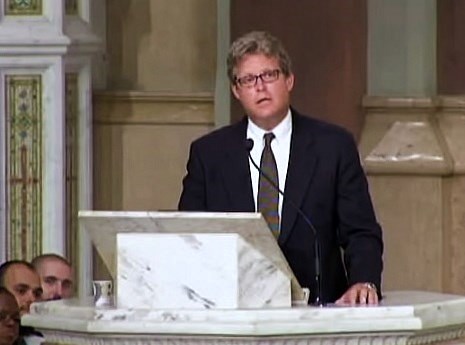
My name is Ted Kennedy Jr. -- a name I share with my son, a name I share with my father. Although it hasn't been easy at times to live with this name, I'[ve] never been more proud of it than I am today.
Your eminence, thank you for being here. You grace us with your presence.
To all the musicians who've come here, my father loved the arts and he would be so pleased for your performances today.
My heart is filled -- and I first want to say thank you -- my heart is filled with appreciation and gratitude. To the people of Massachusetts, my father's loyal staff -- who in many ways, my dad's loss is just as great for them as it is for those of us in our family. And to all of my father’s family and friends who have come to pay their respects, listening to people speak about how my father impacted their lives and the deep, personal connection that people felt with my dad has been an overwhelming emotional experience.
My dad had the greatest friends in the world. All of you here are also my friends, and his greatest gift to me. I love you just as much as he did. Sarah Brown, the Taoiseach [Brian Cowen], President Obama, President Clinton, Secretary Clinton, President Bush, President Carter: You honor my family by your presence here today.
I remember how my dad would tell audiences years ago, "I don't mind not being President. I just mind that someone else is."
There is much to say -- and much will be said -- about Ted Kennedy the statesman, the master of the legislative process and bipartisan compromise, workhorse of the Senate, beacon of social justice, and protector of the people. There is also much to say -- and much will be said -- about my father the man, the storyteller, the lover of costume parties, a practical joker, the accomplished painter.1
He was a lover of everything French: cheese, wine, and women.
He was a mountain climber, navigator, skipper, tactician, airplane pilot, rodeo rider, ski jumper, dog lover, and all-around adventurer. Our family vacations left us all injured and exhausted.
He -- He was a dinner table debater and devil's advocate. He was an Irishman, and a proud member of the Democratic Party.
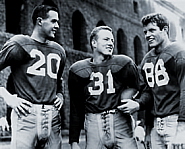
He was a devout Catholic whose faith helped him survive unbearable losses and whose teachings taught him that he had a moral obligation to help others in need.
He was not perfect -- far from it. But my father believed in redemption and he never surrendered -- never stopped trying to right wrongs, be they the results of his own failings or of ours.
But today I am simply compelled to remember Ted Kennedy as my father and my best friend. When I was 12 years old I was diagnosed with bone cancer and a few months after I lost my leg, there was a heavy snowfall over my childhood home outside of Washington D.C. And my father went to the garage to get the old Flexible Flyer and asked me if I wanted to go sledding down the steep driveway. And I was trying to get used to my new artificial leg, and the hill was covered with ice and snow, and it wasn't easy for me to walk. And the hill was -- was very slick and as I struggled to walk, I...slipped and I...I fell on the ice and I...I started to cry. And I said, "I...can't do this." I...said, "I'll never be able to climb up that hill." And he lifted up me in his strong, gentle arms and said something I will never forget. He said, "I know you can do it. There is nothing that you can't do. We're going to climb that hill together, even if it takes us all day."
Sure enough, he held me around my waist and we slowly made it to the top. And, you know, at age 12 losing your leg pretty much seems like the end of the world, but as I climbed onto his back and we flew down the hill that day, I knew he was right. I knew I was going to be okay. You see, my father taught me that even our most profound losses are survivable, and that is -- it is what we do with that loss, our ability to transform it into a positive event, that is one of my father's greatest lessons. He taught me that nothing is impossible.
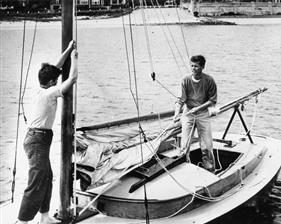
And he just wasn't talking about boating. My father admired perseverance. My father believed that to do a job effectively required a tremendous amount of time and effort.
Dad instilled in me also the importance of history and biography. He loved Boston and the amazing writers, and philosophers, and politicians from Massachusetts. He took me and my cousins to the Old North Church, and to Walden Pond, and to the homes of Herman Melville and Nathaniel Hawthorne in the Berkshires. He thought that Massachusetts was the greatest place on earth. And he had letters from many of its former senators like Daniel Webster and John Quincy Adams hanging on his walls, inspired by things heroic.
He was a civil [w]ar buff. When we were growing up he would pack us all into his car or rented camper, and we would travel around to all the great battlefields. I remember he would frequently meet with his friend Shelby Foote at a particular site on the anniversary of a historic battle, just so he could appreciate better what the soldiers must have experienced on that day. He believed that in order to know what to do in the future, you had to understand the past.
My father loved other old things. He loved his classic wooden schooner, the Mya. He loved lighthouses and his 1973 Pontiac convertible.
My father taught me to treat everyone I meet, no matter what station in life, with the same dignity and respect. He could be discussing arm control with the President at 3:00 p.m. and meeting with a union carpenter for -- on fair wage legislation or a New Bedford fisherman on fisheries policy at 4:30. I once told him that he accidentally left some money -- I remember this when I was a little kid -- on the sink in our hotel room. And he replied "Teddy, let me tell you something." Making all -- "Making beds all day is back-breaking work. The woman who has to clean up after us today has a family to feed." And that's just the kind of guy he was.
He answered Uncle Joe's call to patriotism, Uncle Jack's call to public service, and Bobby's determination to seek a newer world. Unlike them, he lived to be a grandfather, and knowing what my cousins have been through I feel grateful that I have had my father as long as I did.
He even taught me some of life's harder lessons, such as how to like Republicans. He once told me, he said, "Teddy, Republicans love this country just as much as I do." I think that he felt like he had something in common with his Republican counterparts: the vagaries of public opinion, the constant scrutiny of the press, the endless campaigning for the next election; but most of all, the incredible shared sacrifice that being in public life demands.
He understood that -- the hardship that politics has on a family and the hard work and commitment that it requires. He often brought his Republican colleagues home for dinner, and he believed in developing personal relationships and honoring differences. And one of the wonderful experiences that I will remember today is how many of his Republican colleges are sitting here, right before him. That's a true testament to the man. And he always told me that, "Always be ready to compromise but never compromise on your principles." He was an idealist -- and a pragmatist. He was restless -- but patient.
When he learned that a survey of Republican senators named him the Democratic legislator that they most wanted to work with, and that John McCain called him the single most effective member of the U.S. Senate, he was so proud -- because he considered the combination of accolades from your supporters and respect from your sometime political adversaries as one of the ultimate goals of a successful political life.
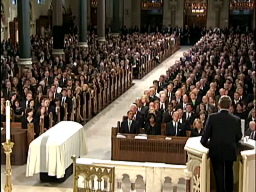 At the end of his life, my dad returned
home. He died at the place he loved more than any other: Cape Cod.
The last months of my dad’s life were not sad or terrifying, but
filled with profound experiences, a series of moments more precious
than I could have imagined. He taught me more about humility,
vulnerability, and courage than he had taught me in my whole life.
At the end of his life, my dad returned
home. He died at the place he loved more than any other: Cape Cod.
The last months of my dad’s life were not sad or terrifying, but
filled with profound experiences, a series of moments more precious
than I could have imagined. He taught me more about humility,
vulnerability, and courage than he had taught me in my whole life.
Although he lived a full and complete life by any measure, the fact is he wasn’t done. He still had work to do. He was so proud of where we had recently come as a nation, and although I do grieve for what might have been, for what he might have helped us accomplish, I pray today that we can set aside this sadness and instead celebrate all that he was, and did, and stood for.
I will try to live up to the high standard that my father...set for all of us when he said, "The work goes on, the cause endures, the hope still lives, and the dream shall never die."
I love you dad. I always will. And I miss you already.